 |
||
James Webb Telescope reveals the earliest Blueprint of Galaxies
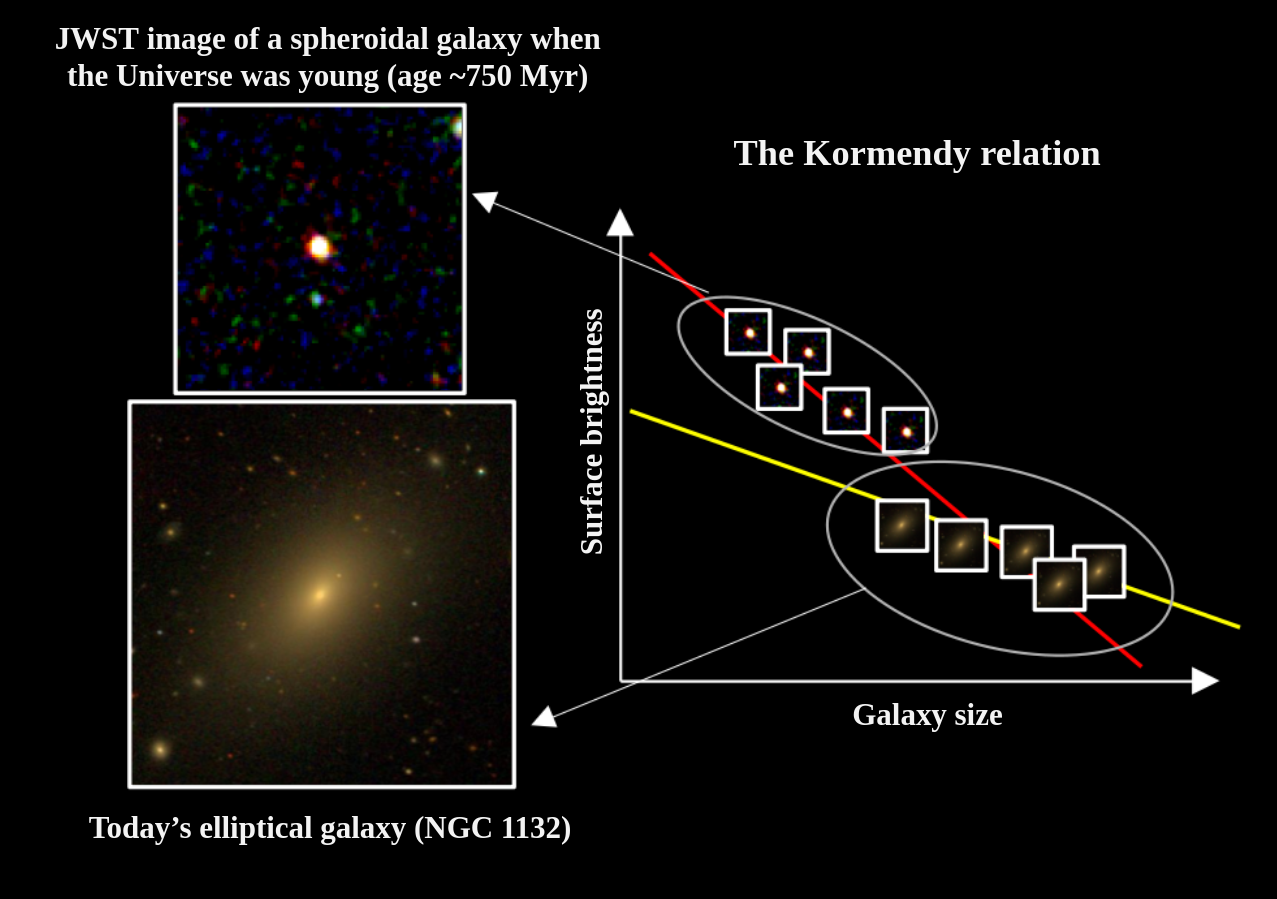
Figure: Top left. One of the spheroidal galaxies from the first billion years of cosmic history used in this research.
False colour RGB image constructed using the JWST Near-Infrared Camera images. The light captured by JWST here left the galaxy more than 13 billion years ago and is only reaching us now. Bottom left: A nearby elliptical galaxy (NGC 1132, credit: SDSS), situated about 318 million light-years away. Right An illustration of the Kormendy relation, comparing the earliest spheroidal systems with elliptical galaxies in the nearby Universe. This study reveals that the early spheroidal systems are systematically brighter and more compact in size. See paper for actual Kormendy relation.
When the Universe was still in its infancy, galaxies were expected to be clumpy, chaotic, rapidly evolving systems still trying to settle down. But new observations from NASA's James Webb Space Telescope (JWST) reveal that some of the earliest galaxies had already become remarkably organized.
Astronomers from the Inter-University Centre for Astronomy and Astrophysics (IUCAA), Pune, have recently discovered that the earliest ‘spheroidal’ galaxies already obeyed one of astronomy's fundamental law of galaxy architecture - the ‘Kormendy relation’ which links a spheroidal (rounded) galaxy's size to its surface brightness. The team studied publicly available deep JWST images of hundreds of very distant galaxies that existed during the early phases of our cosmic history, when the Universe's age was between ∼ 400 – 900 million years old (redshift, z > 6). By carefully measuring how these galaxies' brightness is spread out, they tested whether these baby galaxies also obeyed this well-established relation seen in nearby galaxies.
In simple words, the Kormendy relation states that brighter the central surface brightness the more compact it is and this is one of the local benchmark for spheroidal galaxy's basic structure. The new findings demonstrate that ordered galaxy assembly began remarkably early in the cosmic history, less than one billion years after the Big Bang. The outcome of their research pushes the cornerstone of galaxy evolution farther back in cosmic time than ever before, showing that the physical processes governing galaxy structure were already operating during the Universe's earliest chapters.
Dr. Anshuman Borgohain, the lead author of the study and a post-doctoral fellow at IUCAA, says, “The unprecedented capabilities of JWST continue to reveal exciting findings about the earliest galaxies which challenge our current understanding of how they grew and evolved in an infant Universe. Our findings will directly contribute toward setting a new benchmark for understanding early galaxy assembly.”
Prof. Kanak Saha, who supervised the project said, “For decades, astronomers have used scaling relations such as the Kormendy relation as ‘fossil records’ of galaxy evolution. These relations encode how gravity, star formation, mergers, and gas dynamics shape galaxies over cosmic time. Until JWST, astronomers could measure these relations only for relatively nearby galaxies or those seen several billion years after the Big Bang. The first billion years remained largely unexplored because previous telescopes lacked the sensitivity and resolution needed to study such distant systems. JWST has now opened that frontier”.
Finding the Kormendy relation already established at these redshifts means that the first spheroidal galaxies reached a surprising level of structural maturity far earlier than many models anticipated. The result indicates that the physical mechanisms responsible for organizing galaxies into the familiar structures seen today, emerged almost immediately after the first generations of galaxies formed.
Every massive elliptical galaxy in the local Universe carries a record of its earliest formation history. By observing really early galaxies (at redshifts greater than six (z > 6)), James Webb Telescope is allowing astronomers to witness that history directly rather than reconstructing it from nearby galaxies alone. These observations reveal that the foundations of galaxy architecture were laid astonishingly early, offering an unprecedented glimpse into how galaxies were assembled in the early phase.
The discovery provides a powerful new benchmark for theories of galaxy formation. Future simulations must explain not only how the earliest massive galaxies formed so rapidly, but also why they already obeyed the same underlying structural laws that continue to govern galaxies nearly 13 billion years later.
Astronomers from the Inter-University Centre for Astronomy and Astrophysics (IUCAA), Pune, have recently discovered that the earliest ‘spheroidal’ galaxies already obeyed one of astronomy's fundamental law of galaxy architecture - the ‘Kormendy relation’ which links a spheroidal (rounded) galaxy's size to its surface brightness. The team studied publicly available deep JWST images of hundreds of very distant galaxies that existed during the early phases of our cosmic history, when the Universe's age was between ∼ 400 – 900 million years old (redshift, z > 6). By carefully measuring how these galaxies' brightness is spread out, they tested whether these baby galaxies also obeyed this well-established relation seen in nearby galaxies.
In simple words, the Kormendy relation states that brighter the central surface brightness the more compact it is and this is one of the local benchmark for spheroidal galaxy's basic structure. The new findings demonstrate that ordered galaxy assembly began remarkably early in the cosmic history, less than one billion years after the Big Bang. The outcome of their research pushes the cornerstone of galaxy evolution farther back in cosmic time than ever before, showing that the physical processes governing galaxy structure were already operating during the Universe's earliest chapters.
Dr. Anshuman Borgohain, the lead author of the study and a post-doctoral fellow at IUCAA, says, “The unprecedented capabilities of JWST continue to reveal exciting findings about the earliest galaxies which challenge our current understanding of how they grew and evolved in an infant Universe. Our findings will directly contribute toward setting a new benchmark for understanding early galaxy assembly.”
Prof. Kanak Saha, who supervised the project said, “For decades, astronomers have used scaling relations such as the Kormendy relation as ‘fossil records’ of galaxy evolution. These relations encode how gravity, star formation, mergers, and gas dynamics shape galaxies over cosmic time. Until JWST, astronomers could measure these relations only for relatively nearby galaxies or those seen several billion years after the Big Bang. The first billion years remained largely unexplored because previous telescopes lacked the sensitivity and resolution needed to study such distant systems. JWST has now opened that frontier”.
Finding the Kormendy relation already established at these redshifts means that the first spheroidal galaxies reached a surprising level of structural maturity far earlier than many models anticipated. The result indicates that the physical mechanisms responsible for organizing galaxies into the familiar structures seen today, emerged almost immediately after the first generations of galaxies formed.
Every massive elliptical galaxy in the local Universe carries a record of its earliest formation history. By observing really early galaxies (at redshifts greater than six (z > 6)), James Webb Telescope is allowing astronomers to witness that history directly rather than reconstructing it from nearby galaxies alone. These observations reveal that the foundations of galaxy architecture were laid astonishingly early, offering an unprecedented glimpse into how galaxies were assembled in the early phase.
The discovery provides a powerful new benchmark for theories of galaxy formation. Future simulations must explain not only how the earliest massive galaxies formed so rapidly, but also why they already obeyed the same underlying structural laws that continue to govern galaxies nearly 13 billion years later.
Publication Details
“The Kormendy Relation in the First Billion Years: Evidence from JWST”
Anshuman Borgohain, Kanak Saha.
Published in ApJL, July 2, 2026 [ DOI: 10.3847/2041-8213/ae7e83 ]
Published in ApJL, July 2, 2026 [ DOI: 10.3847/2041-8213/ae7e83 ]
- arXiv: 2604.00104v2
Research contacts:
 |
Dr. Anshuman Borgohain Post Doctoral Fellow, IUCAA, Pune E-mail: anshuman_at_iucaa.in |
 |
Prof. Kanak Saha IUCAA, Pune E-mail: kanak_at_iucaa.in |