 |
||
DZA Enables New Access to the Southern Radio Sky
IUCAA-led MeerKAT survey data now mirrored at DZA
(Deutsches Zentrum für Astrophysik), Germany
IUCAA-led MeerKAT survey data now mirrored at DZA
(Deutsches Zentrum für Astrophysik), Germany
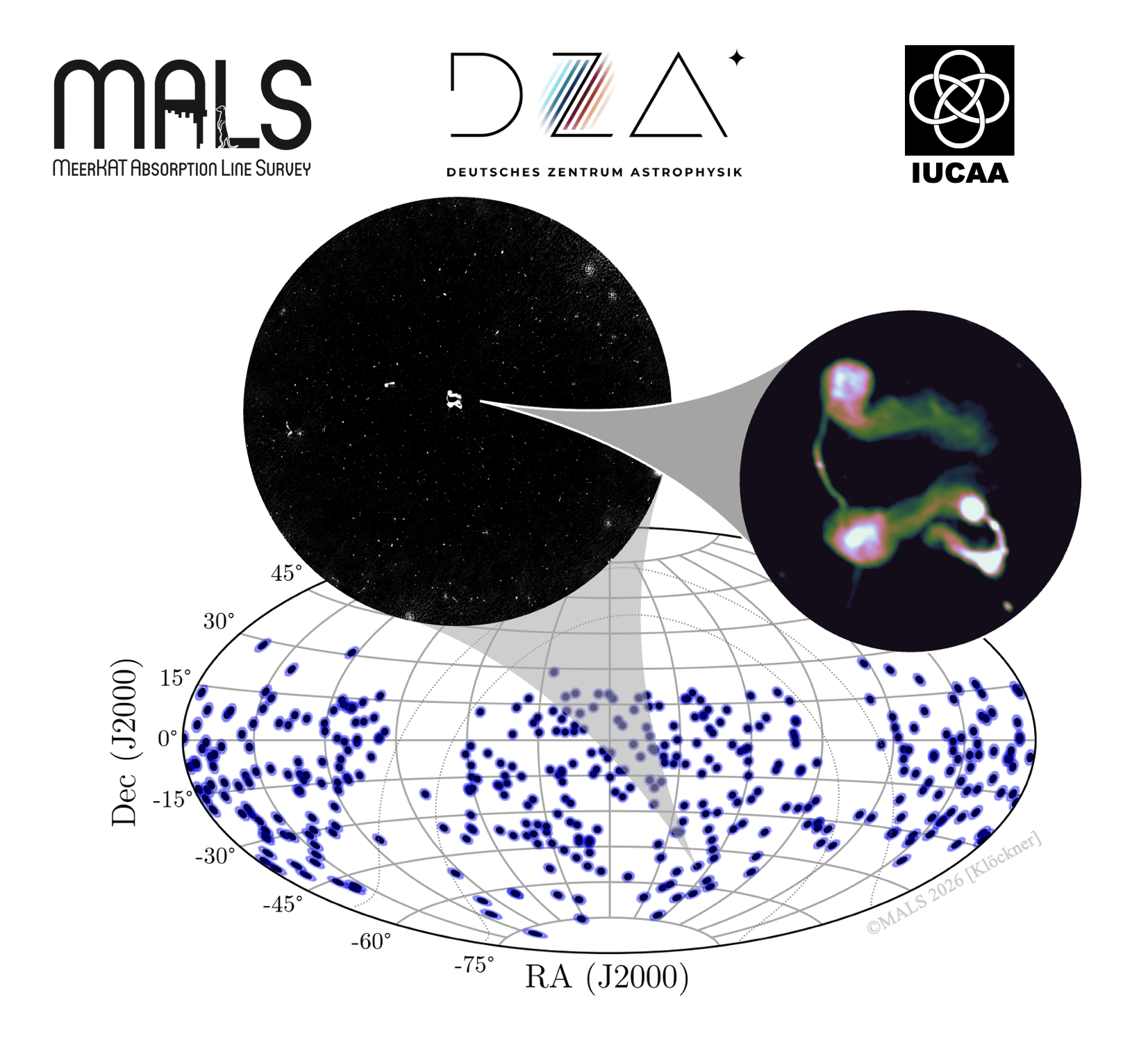
The sky distribution of the 391 MALS pointings is shown, together with a zoomed view of a single pointing containing a few thousand radio sources. The full 1.5 petabytes raw MeerKAT dataset behind this footprint is processed and archived at IUCAA, now also mirrored at DZA for long-term global access.
The Deutsches Zentrum für Astrophysik (DZA) is opening a new gateway to the data products and image archives of the MeerKAT Absorption Line Survey (MALS; https://mals.iucaa.in/), making an important step toward improving access to cutting-edge radio astronomical data for the science community.
“MALS is entering its most productive phase. The DZA mirror ensures continuous long term access to outputs from this 1.5-petabyte dataset for the global scientific community, extending the legacy of the survey well beyond its primary results.” says Prof. Neeraj Gupta (IUCAA, PI of MALS).
The initiative is the result of a close collaboration between the IT Group at DZA in Görlitz, Germany, and the IT Department of the Inter-University Centre for Astronomy and Astrophysics (IUCAA) in Pune, India. Together, the teams have established the first foundation to a data service infrastructure designed to support researchers working with the rapidly growing data volumes produced by modern radio astronomical surveys. On the IUCAA side, the mirror setup was coordinated by Mr. Dhanraj Borgaonkar.
“MALS is a prototype for the DZA to lay the groundwork for the SKA and the deSRC work. The continuous and error-free operation of data-driven services for researchers from around the world will be a key component of our portfolio.” says Dr. Lars Haupt (DZA)
MALS has reached a major milestone with the successful completion of its full observing campaign. By the end of 2025, all 1,400 hours of planned observations had been carried out, resulting in an unprecedented dataset of approximately 1.5 petabytes of raw data. This achievement marks the transition of MALS from data acquisition to scientific exploitation. With three major public data releases already available and additional releases planned, the survey is poised to deliver transformative insights into how galaxies acquire, retain, and regulate the gas that fuels star formation across cosmic history.
The public releases to date have primarily focused on observations obtained in the L-band frequency range between 900 and 1670 MHz. The forthcoming release of data from the Ultra High Frequency (UHF) band, spanning 580 to 1015 MHz, will significantly extend the survey's scientific capabilities. These observations will provide deeper continuum images, expanded spectral-line coverage, and increased sensitivity to more distant galaxies, enabling astronomers to probe earlier epochs in the evolution of the Universe.
“The DZA will utilise MALS data to provide a unique and accurate view of the polarised sky at unprecedented detail that will facilitate the study of magnetisation of our Universe.” says Dr. Aritra Basu (DZA)
The new gateway represents an important milestone in DZA's commitment to fostering international collaboration, advancing open science, and strengthening the digital infrastructure required for next-generation astronomical research. As the service expands, it will provide the German radio astronomy community and international partners with access to valuable MALS data, supporting discoveries in galaxy evolution, the interstellar medium, and the large-scale structure of the Universe.
This first deployment lays the groundwork for future distributed data services and demonstrates the power of international cooperation in addressing the challenges of data-intensive science.
MALS@amp;DZA: https://mals.project.dzastro.de
“MALS is entering its most productive phase. The DZA mirror ensures continuous long term access to outputs from this 1.5-petabyte dataset for the global scientific community, extending the legacy of the survey well beyond its primary results.” says Prof. Neeraj Gupta (IUCAA, PI of MALS).
The initiative is the result of a close collaboration between the IT Group at DZA in Görlitz, Germany, and the IT Department of the Inter-University Centre for Astronomy and Astrophysics (IUCAA) in Pune, India. Together, the teams have established the first foundation to a data service infrastructure designed to support researchers working with the rapidly growing data volumes produced by modern radio astronomical surveys. On the IUCAA side, the mirror setup was coordinated by Mr. Dhanraj Borgaonkar.
“MALS is a prototype for the DZA to lay the groundwork for the SKA and the deSRC work. The continuous and error-free operation of data-driven services for researchers from around the world will be a key component of our portfolio.” says Dr. Lars Haupt (DZA)
MALS has reached a major milestone with the successful completion of its full observing campaign. By the end of 2025, all 1,400 hours of planned observations had been carried out, resulting in an unprecedented dataset of approximately 1.5 petabytes of raw data. This achievement marks the transition of MALS from data acquisition to scientific exploitation. With three major public data releases already available and additional releases planned, the survey is poised to deliver transformative insights into how galaxies acquire, retain, and regulate the gas that fuels star formation across cosmic history.
The public releases to date have primarily focused on observations obtained in the L-band frequency range between 900 and 1670 MHz. The forthcoming release of data from the Ultra High Frequency (UHF) band, spanning 580 to 1015 MHz, will significantly extend the survey's scientific capabilities. These observations will provide deeper continuum images, expanded spectral-line coverage, and increased sensitivity to more distant galaxies, enabling astronomers to probe earlier epochs in the evolution of the Universe.
“The DZA will utilise MALS data to provide a unique and accurate view of the polarised sky at unprecedented detail that will facilitate the study of magnetisation of our Universe.” says Dr. Aritra Basu (DZA)
The new gateway represents an important milestone in DZA's commitment to fostering international collaboration, advancing open science, and strengthening the digital infrastructure required for next-generation astronomical research. As the service expands, it will provide the German radio astronomy community and international partners with access to valuable MALS data, supporting discoveries in galaxy evolution, the interstellar medium, and the large-scale structure of the Universe.
This first deployment lays the groundwork for future distributed data services and demonstrates the power of international cooperation in addressing the challenges of data-intensive science.
MALS@amp;DZA: https://mals.project.dzastro.de
People involved:
- DZA: Chithralekha Desing Raja, Lars Haupt, Sagar Borra, Marc Drobek, Hermann Hessling, Aritra Basu, Stefan Wagner & the CIDS Admin Team.
- IUCAA: Dhanraj Borgaonkar, Yogesh Thakare, Neeraj Gupta and IUCAA IT team.
- MPIfR: Hans-Rainer Klöckner
Contact:
For questions, please contact mals@dzastro.de or reach out directly to the following individuals: |
Prof. Neeraj Gupta
IUCAA, Pune E-mail: ngupta_at_iucaa.in |
 |
Dr. Hans-Rainer Klöckner MPIfR, Germany E-mail: hrk_at_mpifr-bonn.mpg.de |
 |
Dr. Aritra Basu DZA, Germany E-mail: abasu_at_mpifr-bonn.mpg.de |
 |
Mr. Dhanraj Borganokar IUCAA, Pune E-mail: dhanraj_at_iucaa.in |