 |
||
A Pair of Dead Stars Locked in a Six-Minute Orbit
is Rapidly Spiraling Inward
is Rapidly Spiraling Inward
A newly studied binary star system composed of two burnt-out stellar remnants is losing energy and shrinking its orbit faster than almost any other system of its kind ever observed, making it one of the most promising targets for future gravitational-wave observatories in space.
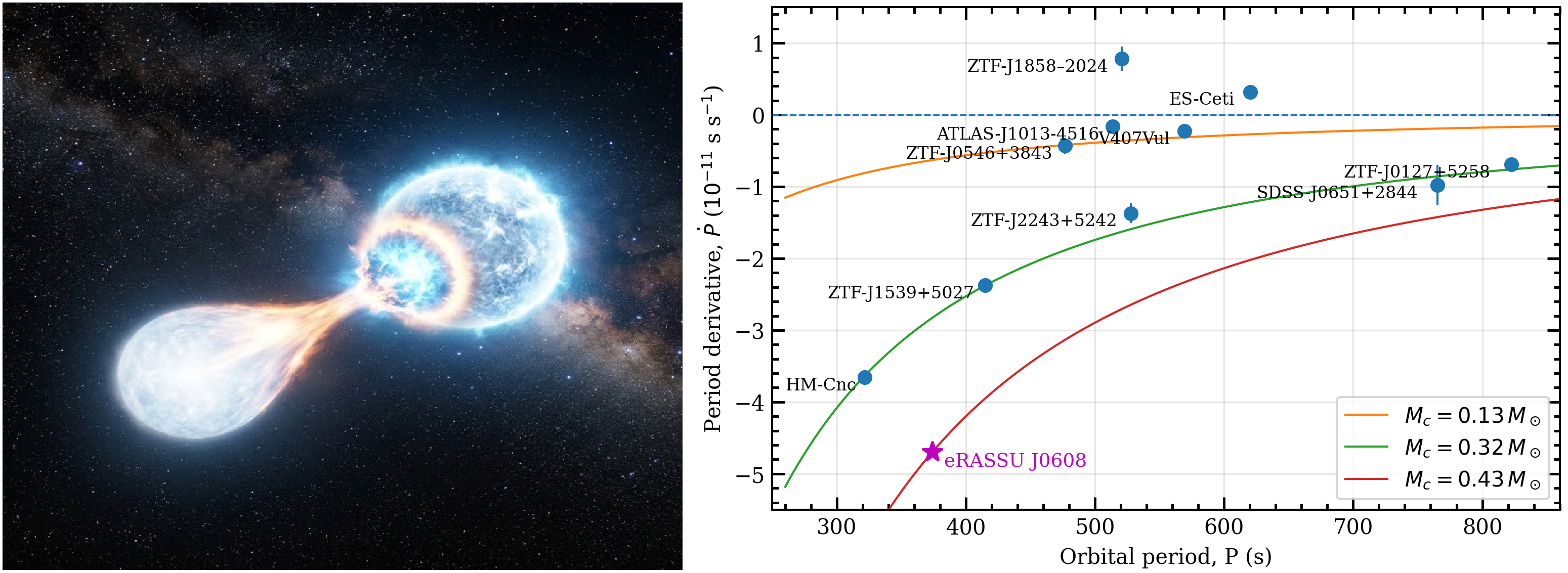
Figure (left): Artistic impression of a double white dwarf binary, powered by direct-impact accretion of a stream from the companion white dwarf to a more massive white dwarf. (Right): The compactness v/s decay rate for the known white dwarf pairs. eRASSU J0608 (star marker) sits lower and further left than almost every other system, orbiting almost as tightly as HM Cnc (the current record holder) while shrinking at a still-faster rate, evidence that this newly studied pair is one of the strongest predicted sources of gravitational waves among all such systems known today.
An international team led by Indian astronomers has found that a pair of dead stars spiralling towards each other at record speed. Using observations from the Chinese-led Einstein Probe mission and NASA’s NICER telescope, the team found that a pair of white dwarfs, the dense dead cores left behind when stars like the Sun run out of fuel, are locked in an extraordinarily tight orbit. That orbit is shrinking fast, a telltale sign that the system is radiating away energy as gravitational waves.
The system, originally discovered with the SRG eROSITA all-sky survey, is known as eRASSU J060839.5–704014 (or “eRASSU J0608” for short). The two stars circle each other once every six minutes. Their orbit is decaying faster than almost any other known system of its kind. The study, led by Dr. Rahul Sharma and Prof. Chandreyee Maitra, was recently published in The Astrophysical Journal Letters (ApJL).
eRASSU J0608 is one of the most extreme examples known. One of the prominent theories describing its radiation is two white dwarfs that are so close together that material is thought to be flowing directly from one star and slamming into the surface of the other, rather than settling into a swirling disk first. Astronomers call this “direct-impact accretion”. The impact heats the surface to temperatures of over a million degrees, producing a bright, pulsing glow of X-rays that repeats every 374 seconds, the orbital period of the binary.
The rapid orbital decay is most likely driven primarily by the loss of energy and angular momentum through gravitational waves (ripples in spacetime). As they lose energy, they spiral closer together and speed up. The faster the orbit shrinks, the stronger the gravitational-wave signal the system is expected to produce.
From the measured rate of orbital decay, the team estimates the combined “chirp mass” of the two white dwarfs (a quantity that determines how strong their gravitational-wave signal will be) at about 0.43 times the mass of the Sun, among the highest values known for this class of object.
Dr. Rahul Sharma, the lead author of the study and a Post-Doctoral fellow at IUCAA, says, “This system is spiraling inward so quickly that it stands out even among the most extreme examples we know of. These systems are an important new laboratory for studying a fleeting phase in the evolution of the most compact stellar binaries.” Prof. Chandreyee Maitra said, “The measurements indicate that eRASSU J0608 may be among the most massive and rapidly evolving ultracompact white dwarf binaries currently known. Its rapid orbital evolution also makes it a promising verification source for future space-based gravitational-wave observatories such as LISA.”
The team plans to continue monitoring the system with X-ray telescopes and to search for a visible-light counterpart. That could help pin down its distance and mass more precisely, and sharpen predictions for what LISA and other future missions will eventually detect.
The system, originally discovered with the SRG eROSITA all-sky survey, is known as eRASSU J060839.5–704014 (or “eRASSU J0608” for short). The two stars circle each other once every six minutes. Their orbit is decaying faster than almost any other known system of its kind. The study, led by Dr. Rahul Sharma and Prof. Chandreyee Maitra, was recently published in The Astrophysical Journal Letters (ApJL).
Two dead stars, one tiny orbit
White dwarfs are what remain after a Sun-like star exhausts its nuclear fuel and sheds its outer layers. What's left is an extremely dense core roughly the size of Earth but packing the mass of a star. When two white dwarfs end up orbiting each other at very close range, they form what astronomers call an “ultracompact“ binary system. The orbit is so tight that a complete orbit can take just minutes rather than years. These double white-dwarf systems with such extraordinarily short periods are among the most compact binaries known. They are thought to be passing through a brief, special stage of stellar evolution, one where gravitational waves strongly influence their orbital motion. Some of these binaries are possible progenitors of certain types of supernova explosions. Studying how they lose orbital energy over time helps astronomers understand the physics of extremely compact binaries in general.eRASSU J0608 is one of the most extreme examples known. One of the prominent theories describing its radiation is two white dwarfs that are so close together that material is thought to be flowing directly from one star and slamming into the surface of the other, rather than settling into a swirling disk first. Astronomers call this “direct-impact accretion”. The impact heats the surface to temperatures of over a million degrees, producing a bright, pulsing glow of X-rays that repeats every 374 seconds, the orbital period of the binary.
A shrinking orbit and a clue to gravity itself
By combining new observations from the NICER and Einstein Probe missions with earlier data from the XMM-Newton observatory, the team precisely tracked the system's orbit over a baseline of three and a half years. They found that it is shrinking exceptionally rapidly, at a rate even greater than that measured in the two other well-known systems of this class, HM Cnc and V407 Vul.The rapid orbital decay is most likely driven primarily by the loss of energy and angular momentum through gravitational waves (ripples in spacetime). As they lose energy, they spiral closer together and speed up. The faster the orbit shrinks, the stronger the gravitational-wave signal the system is expected to produce.
From the measured rate of orbital decay, the team estimates the combined “chirp mass” of the two white dwarfs (a quantity that determines how strong their gravitational-wave signal will be) at about 0.43 times the mass of the Sun, among the highest values known for this class of object.
A future target for space-based gravitational-wave detectors
Because its gravitational-wave signal is expected to be so strong and so predictable, eRASSU J0608 is exactly the kind of source that future space-based observatories are designed to detect. The European Space Agency's planned LISA (Laser Interferometer Space Antenna) mission, expected to launch in the next decade, will listen for gravitational waves from exactly this kind of tight, whirling pair of stellar remnants. Systems like eRASSU J0608, whose signals can already be predicted from X-ray timing, serve as “verification sources”: known binaries whose gravitational-wave signals can be checked against LISA's actual measurements once the mission is in space.Dr. Rahul Sharma, the lead author of the study and a Post-Doctoral fellow at IUCAA, says, “This system is spiraling inward so quickly that it stands out even among the most extreme examples we know of. These systems are an important new laboratory for studying a fleeting phase in the evolution of the most compact stellar binaries.” Prof. Chandreyee Maitra said, “The measurements indicate that eRASSU J0608 may be among the most massive and rapidly evolving ultracompact white dwarf binaries currently known. Its rapid orbital evolution also makes it a promising verification source for future space-based gravitational-wave observatories such as LISA.”
The team plans to continue monitoring the system with X-ray telescopes and to search for a visible-light counterpart. That could help pin down its distance and mass more precisely, and sharpen predictions for what LISA and other future missions will eventually detect.
Publication Details
“Rapid Orbital Decay in the Ultracompact Double-degenerate Binary eRASSU J060839.5–704014”
Rahul Sharma, Chandreyee Maitra, et al., 2026.
Published in The Astrophysical Journal Letters (ApJL), August 10, 2026. [ DOI: 10.3847/2041-8213/ae8cf7 ]
Rahul Sharma, Chandreyee Maitra, et al., 2026.
Published in The Astrophysical Journal Letters (ApJL), August 10, 2026. [ DOI: 10.3847/2041-8213/ae8cf7 ]
- arXiv: Click here
Research contacts:
 |
Dr. Rahul Sharma Post Doctoral Fellow, IUCAA, Pune E-mail: rahul.sharma_at_iucaa.in |
 |
Prof. Chandreyee Maitra Associate Professor, IUCAA, Pune. Head, IUCAA–MPE Max Planck Partner Group E-mail: chandreyee.maitra_at_iucaa.in |