 |
||
eROSITA DR2 opens a deeper view of the X-ray sky -
and reveals the first symbiotic accreting system in the Magellanic Bridge
and reveals the first symbiotic accreting system in the Magellanic Bridge
By surveying the entire sky in X-rays with unprecedented sensitivity, eROSITA has transformed our view of the high-energy Universe, revealing both vast populations of cosmic sources and rare objects in previously unexplored environments. The second public data release from the German eROSITA Consortium contains nearly two million X-ray sources, while an IUCAA-led study showcases how the survey is uncovering rare stellar systems in the space between the Magellanic Clouds.
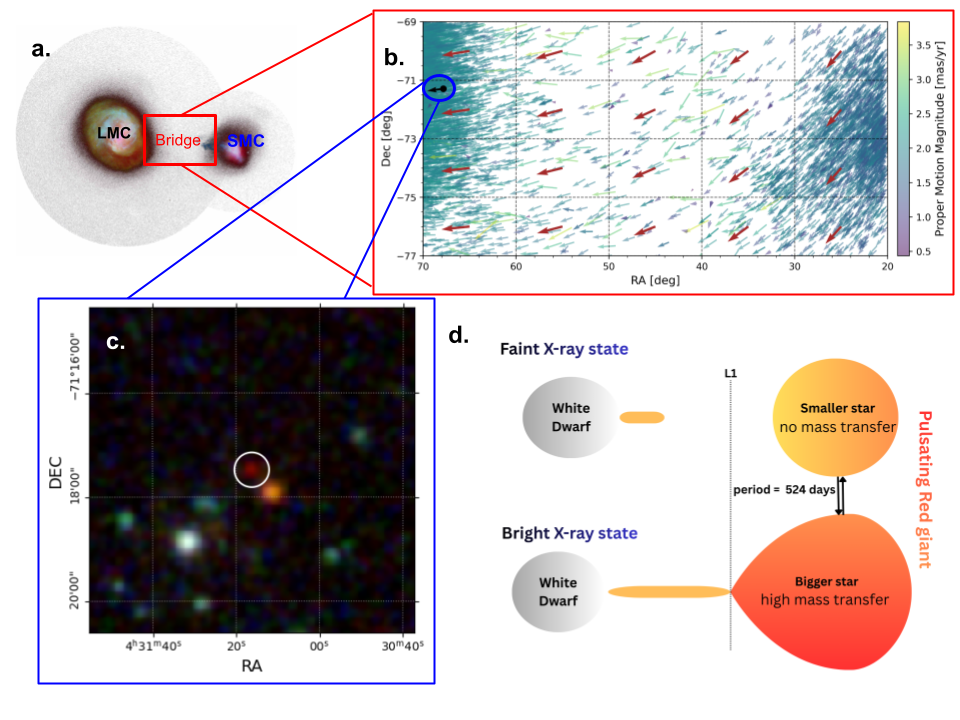
Figure 1. (a) Gaia positions of the stars in the Magellanic Bridge (Image credit: ESA/Gaia/DPAC) (b) the proper motion of the old stars in the Magellanic Bridge indicating the flow of stellar objects from the SMC to the LMC. The black marker and the arrow originating from it represents the position and the direction of proper motion of J0431-71 respectively. The brown arrows in each cell delineated by the dashed line is the average proper motion of the stars in the corresponding cell. (c) RGB false color image of the closer look of the field around J0431-71 (d) the mechanism that drives the multi-wavelength variability in J0431-71.
Expanding our view of the X-ray Universe: eROSITA-DE releases its second collection of public source catalogues
The German eROSITA Consortium (eROSITA-DE), led by the Max Planck Institute for Extraterrestrial Physics (MPE), has released its second major public dataset, eROSITA Data Release 2 (DR2). Combining the first three all-sky surveys (eRASS1–3), obtained over 556 days, DR2 nearly doubles the number of catalogued X-ray sources to close to two million. It includes more than 1.9 million point-like sources and around 64,000 extended sources, such as galaxy clusters and supernova remnants. The release also provides six new multi-wavelength catalogues that link X-ray detections to their likely optical and infrared counterparts, enabling more reliable source classification and distance estimates. DR2 therefore offers a powerful resource for studying compact objects and X-ray-binary populations in the Milky Way and its neighbouring galaxies. The Magellanic System is especially well covered because of its location near the South Ecliptic Pole, where repeated survey scans provide some of eROSITA’s deepest exposures. One of the science studies accompanying the release presents the discovery and characterisation of eRASSU J043115.8−711730, the first known symbiotic accreting system in the Magellanic Bridge. The study was led by Dr. Tathagata Saha and Prof. Chandreyee Maitra of IUCAA.The Magellanic Bridge – a template for archaeology of galactic interactions
The Magellanic Bridge is the region of high stellar and gas density stretching between the Large Magellanic Cloud (LMC) and Small Magellanic Cloud (SMC), the two nearest satellite galaxies of the Milky Way. It is thought to be a relic from the tidal interaction between the two galaxies and serves as a natural laboratory for studying how galaxy interactions affect star formation and evolution. This region has been studied effectively in the optical and infrared bands with multiple optical and infrared surveys, such as Gaia, WISE, and 2MASS. These surveys have shown that the Bridge contains two distinct stellar groups: a young population that likely formed in situ, and an older population that was probably tidally stripped from the SMC during its interaction with the LMC. However, the X-ray-emitting population of the Magellanic Bridge has largely remained hidden. This includes compact objects such as white dwarfs, neutron stars and black holes, which represent the endpoints of stellar evolution. These objects may have very high surface temperatures or may be undergoing energetic processes such as accretion, making X-ray observations essential for detecting and characterising them. eROSITA's wide-field sensitivity and repeated sky coverage now make it possible to search systematically for these hidden endpoints of stellar evolution across the Magellanic Bridge.A rare system in the Magellanic Bridge
eROSITA, onboard the Spektrum-Roentgen-Gamma spacecraft, has observed the Bridge in X-rays for the first time, with sensitivity high enough to detect multiple X-ray-bright sources. By cross-matching the eROSITA detections with catalogues of extragalactic sources and nearby bright stars, and by using Gaia proper motions, the team excluded likely foreground stars and background objects. This produced a cleaner sample of sources that are likely to lie in the Bridge and are suitable for detailed multi-wavelength follow-up.One such object is eRASSU J043115.8-711730 (J0431-71 hereafter). A coordinated effort involving scientists from the eROSITA-DE Consortium, the SALT collaboration and the OGLE team led to the discovery of a unique system associated with the Magellanic Bridge, a white dwarf accreting material from a pulsating red giant companion known as symbiotic white dwarf systems. The red-giant star swells and shrinks in a regular cycle lasting about 500 days. As it expands, some of its gas spills onto the nearby white dwarf, where it produces the observed X-rays (Saha, Maitra et al. 2026).The X-ray emission may be intermittently powered by the nuclear burning on the surface of the white dwarf. The source’s motion on the sky is also consistent with the local kinematics of the older stellar population in the Bridge. This strengthens the case that the system belongs to the tidally disturbed Magellanic environment rather than being an unrelated foreground or background object. As the first known symbiotic accreting system in the Bridge, J0431−71 provides a new tracer of both compact-object evolution and the dynamical history of the region.
Why this discovery matters
The discovery illustrates the scientific reach of the eROSITA all-sky survey: the same homogeneous dataset that enables population studies of millions of X-ray sources can also uncover rare individual systems in previously underexplored environments. Compact binaries preserve information about the age, chemical composition and how they are formed. Finding and studying these systems in the Magellanic Bridge can help us understand how close encounters between galaxies influence the way binary stars form, evolve and survive. Finding and studying these systems in the Magellanic Bridge can help us understand how close encounters between galaxies affect the way binary stars form, evolve and survive. This discovery is part of a broader effort to build the first X-ray census of compact objects across the Magellanic System. By moving from individual discoveries to a larger population, researchers will be able to compare stellar evolution in the Bridge with that in the Large and Small Magellanic Clouds, and gain a clearer picture of how interactions between neighbouring galaxies shape their stars over time.“DR2 transforms eROSITA's repeated sky scans into a remarkably deep and uniform catalogue. J0431−71 is a striking example of what becomes possible when this X-ray survey is combined with optical spectroscopy and long-term monitoring: we can not only discover a rare accreting binary, but also use it to investigate how compact objects form and evolve in a tidally interacting galactic environment.”
- Chandreyee Maitra, Associate Professor at IUCAA, Head of the Max Planck partner group of IUCAA-MPE and Chair of the Compact Objects Working Group of the eROSITA-DE Consortium
“This supersoft symbiotic binary system powered by accretion of matter from a pulsating red-giant is the first of its kind discovered in the Magellanic Bridge. The discovery of this source has been enabled by the unprecedented sensitivity and extensive coverage of the Bridge region by eROSITA surveys, bringing in a new era of time domain studies of evolving stellar populations in interacting galaxies.”
- Tathagata Saha, Postdoctoral Fellow at IUCAA and a member of the eROSITA-DE Consortium
Publication Details
“eRASSU J043115.8-711730: The first pulsating symbiotic super-soft X-ray source in the Magellanic Bridge”
Tathagata Saha, Chandreyee Maitra, et al., 2026.
Published in Royal Astronomical Society, July 30, 2026 [ DOI: arXiv:2607.27730 ]
Tathagata Saha, Chandreyee Maitra, et al., 2026.
Published in Royal Astronomical Society, July 30, 2026 [ DOI: arXiv:2607.27730 ]
- eROSITA-DE DR2 archive: Click here
- MPE DR2 press release: Click here
Note for Editors
eROSITA is the soft X-ray telescope aboard the Spektrum-Roentgen-Gamma mission. The German eROSITA Consortium is led by the Max Planck Institute for Extraterrestrial Physics and includes partner institutes in Germany, with support from the German Aerospace Center and the Max Planck Society. eROSITA was launched on 13 July 2019 and completed four full scans of the sky before entering safe mode in February 2022. DR2 is based on the combined first three surveys and is a catalogue-focused public release. Chandreyee Maitra, Associate Professor at IUCAA, and head of the Max Planck partner group of IUCAA-MPE is the Chair of the Compact Objects Working Group of the consortium.Research contacts:
 |
Dr. Tathagata Saha Post Doctoral Fellow, IUCAA, Pune E-mail: tathagata.saha_at_iucaa.in |
 |
Prof. Chandreyee Maitra Associate Professor, IUCAA, Pune. Head, IUCAA–MPE Max Planck Partner Group E-mail: chandreyee.maitra_at_iucaa.in |