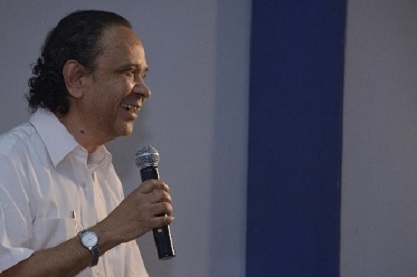
Director, IIA and the entire IIA family
It is with deep sadness, we at the Indian Institute of Astrophysics mourn the passing of Professor Thanu Padmanabhan, or Paddy as he was known to all. Paddy was an extraordinary scientist in the area of theoretical physics and astrophysics. His passion was of course gravitation and cosmology, where he made tremendous contributions to understanding the cosmological constant, structure formation, approaches to Quantum gravity, and gravity as an emergent phenomenon. He was a great teacher and mentor, and an inspiring writer of numerous textbooks and review articles which have been constant companions to students around the world. He wrote a number of popular science books as well. Paddy was a Distinguished Professor at the Inter-University Centre for Astronomy and Astrophysics or IUCAA, Pune where he lived. He was the recipient of numerous awards from India and abroad. The theoretical physics and astronomy community has lost a great and visionary leader.
IIA was fortunate to have Prof. Padmanabhan deliver the Vainu Bappu Memorial Lecture in 2013 on ‘Conceptual Conundrums in Cosmology’. The institute also had a close relationship with him in a context that many would not associate with his research, namely that of large observatory projects. As the convenor of the National Advisory Committee set up in 2008 by the various funding agencies to decide which of the large international optical telescope projects India should be a part of, he played a key role in bringing together people and articulating the need for India's participation to government bodies. Our current participation in the Thirty Meter Telescope project owes a lot to his efforts.
A P Radhakrishna
It was 2007. I got an opportunity to attend IUCAA Refresher course. That was the memorable experience of my life. Prof.Padmanabhan took classes on Quantum Mechanics to General theory of relativity. Those lectures were mesmerizing. I still remember, he used to write equations after equations at different places on huge black board effortlessly by both the hands, finishing the lecture at apt time - connecting all those equations - like great artist completing his beautiful art. In the tea hours, we participants did discussion with Prof.Padmanabhan, he was gentle and patiently clarifying our doubts. Those discussion provided us new perspective on Physics. I have his three volumes of Theoretical Astrophysics. They are the real treasure for me. Each one runs more than five hundred pages, monumental testimony for the depth of knowledge of Prof.Padmanbhan and his immense contribution to Astrophysics and Cosmology. If I say, many of present day forefront Astrophysicists and cosmologists are one or other ways richly influenced by Prof.T Padmanabhan, is not an exaggeration. Passing away of Prof.T Padmanabhan has surely created a void, too difficult to fulfil. His books, essays, research papers, video lectures are giving light to show the path.
Rajeev Sarada
I met Padmanabhan (he did not re-brand himself “Paddy” until he left Trivandrum) when he was a pre-degree student at the Govt Arts College in Trivandrum and I was in tenth standard. It would be considered his last year of High School today, but this was before the plus two system was introduced.
I met him at a meeting of the Science Society of Trivandrum, along with its chief, V. Parameswaran Nair. This was a student-run organization founded a few years before by Arun Kumar (now the CEO of KPMG, India).
Meeting them transformed my life. I had by then learned some physics and mathematics on my own, mainly because I wanted to find out how airplanes worked. Through them I heard about the Feynman Lectures in Physics and realized that physics explained not only airplanes, but every other amazing thing about the physical world.
Padmanabhan and Parameswaran both totally blew me away in that first meeting. Not just the depth and breadth of their knowledge, but their value system resonated with me. Everything had to be examined from the bottom up, taken apart and put back together in your own way. Trying to keep up with their conversation (what the heck is a “Hamiltonian”?) spurred me on to learn fast.
There were many other sides to Padmanabhan. Although not well off, he was from a very cultured background. It was a revelation to me that people could value knowledge for its own sake and not for a job or prestige it would bring them. He would tell me about the philosophical message underlying the Ramayana and Mahabharatha. That the commentaries of Shankara were in the form of dialogues with an imaginary opponent. That Kerala once had a great tradition in Mathematical Astronomy. Each of these insights have guided my life in the years since, although they were no more than casual comments for him.
We also shared a common interest in British detective fiction. The day I finally beat him at chess (after many, many losses) is a clear memory.
Those were years of intense competition and curiosity. I remember looking at the book on Classical Mechanics by Goldstein at the University Library. Someone had recently put a check mark next to various problems. It could not have been Parameswaran, as he had already learned it some years ago. So it had to be Padmanabhan, marking his own progress. I made it a point to solve not only the problems he had solved, but also the remaining ones. Among them was rigid body motion, a favorite topic to this day.
He was more impressed than me by the gigantic book by Misner, Thorne and Wheeler. I preferred the austere discussion of General Relativity in Landau Lifshitz (Classical Theory of Fields). In Padmanabhan's own book on Gravity, I see traces of some of our early arguments.
We left Trivandrum the same year: TIFR for him and Syracuse for me. Our contacts since then have been sporadic. But not a week goes by that I am not reminded of some conversation from those early years. For example, last week, a colleague asked me a tricky question about Faraday's law. I knew the answer because Padmanabhan and I had argued about this back then.
Padmanabhan's legacy is not only his impressive research output and the excellent books. It is also the many people whom he inspired and trained to do physics. It seems so unfair that he will not be around another twenty years to create yet another generation of scientists. The only consolation is that one of his students will continue the tradition. Indian physics will forever have the imprint of Padmanabhan in its DNA.
Christian (Krish) Boily
I simply can't believe that Paddy has left us so soon, so suddenly. Please accept my heartfelt condolences, this will take you all so much time and strength to comprehend and accept. I think we can all take comfort in the knowledge that he has inspired many fresh ideas over the years - and will continue to do so, somehow.
I remember my short time as a post-doc at IUCAA over many years back, how the whole place was vibrant and a truly stimulating environment. But aside from lecture halls, computers and libraries, it was the tea breaks that were so profitable science-wise from my perspective: that's because of the unique open-minded approach to asking questions and looking at things that he (and others) instilled in us, post-docs and students. How wonderful it was to have (almost) everything sorted out on a table top, using sugar cubes and tea cups as props .. I still have hand-written notes of problems we worked on, problems that continue to provide a metric for my research today. Ideas run deep.
I don't want to end on a sad note - Paddy radiated with positive energy, it should stay that way. So instead, let me tell you an anecdote. Maybe it will make you smile. We had been looking at the Boltzmann equation to figure out how a (dry) galaxy merger should best evolve. There is some path integral calculation involved. There is a quantity called entropy we needed to compute. And I had come to believe that the best answer was a minimum (!) of that quantity - had to be, for such and such reasons. Tea time came up, so I went along with my plots / graphs. I proudly showed them to Paddy, and I explained this thing we had gotten wrong, surely, needed to be looked at again, etc. "~ Ok, let's go to my office and we can clear this up", he said to me. Once in his office, I showed him the plots again : "~ Funny how everything seems to run backwards in these plots .. ? ". It wasn't funny to me at first - but he'd spotted that the plots had been drawn in the wrong _frame_, somehow a minus sign was forgotten .. we both laughed, and I was thankful for that gentle remark that saved me / us so much effort! Pure thinker, and a class act.
Salut, Paddy!