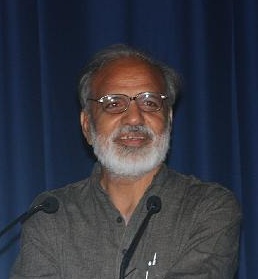
Sunil Tambe
This is Sunil Tambe's post:
This post is about a man I was infinitely fond of for the four or seven evenings/nights when we volleyed on everything from Einstein's relativity to Ramanujan's Goddess of Namakkal and the notion of righteous behavior in public. What a man! I cannot think of more than 3-4 persons who wear their knowledge so lightly.
Naresh Dadhich, former Director and Scientist at the Inter-University Centre for Astronomy and Astrophysics (IUCAA), Pune, passes away in Beijing (China) due to a heart attack. He was 81 years old.
Naresh was born in a small village in Churu district, Rajasthan — a village that did not even have a school. After completing his schooling, he went to the Birla Institute of Technology and Science (BITS), Pilani (Rajasthan) for higher education. Later, he came to Pune University to continue his studies. He eventually became a professor of mathematics at Pune University and later the head of the Mathematics Department. Though he took an interest in university politics, his main focus remained on research.
His area of contemplation and study was the classical theory of gravitation (Newton) and quantum theory. Naresh played an important role in the conception and establishment of IUCAA. He was the one who persuaded Dr. Jayant Narlikar to accept the post of Director. Under Narlikar’s leadership, the foundation of a fundamental research institute was laid. The responsibility for designing the buildings of the institute was given by Narlikar to architect Charles Correa.
Correa believed that just as Indian artists — whether Hindu, Muslim, or Christian — infused their worldview and philosophy into their architectural creations, the buildings of a scientific research institute too should visually express scientific ideas. He discussed this concept in detail with Dr. Narlikar, Dr. Dadhich, and the institute’s researchers — and thus the IUCAA campus came into being.
The Yuvak Kranti Dal (Youth Revolution Party) was founded during a camp on Sinhagad Fort, in which Naresh had also participated. His first friend in Pune was Atul Gore, through whom he became active in social and political movements. However, the foundation for his intellectual outlook had been laid by his elder brother, who had studied the works of Kabir.
While in college, Naresh had read and absorbed Marriage and Morals by Bertrand Russell. He also read literature by Kafka, Camus, and other Western writers, along with Hindi and Marathi literature. D. K. Bedekar was a close friend of his, as were Anil Avachat and Subhash Avachat. He often visited Subhash’s native village, Otur. Naresh had a deep appreciation for art, sculpture, literature, poetry, and theatre across different languages and cultures.
He once wrote a powerful rebuttal to M. P. Rege’s essay Why I Am a Theist. He also had a close relationship with Vasant Palshikar, with whom he had many discussions — one of which the author personally witnessed.
Naresh became associated with the Narmada Bachao Andolan (Save Narmada Movement). As a scientist, he spent some time in South Africa, and when Nelson Mandela took the oath as President, Naresh was an invited national guest at the ceremony. He also became friends with Mandela’s associates. He shared a close friendship with Prakash Ambedkar as well. When Mandela’s colleagues visited Pune, Naresh hosted them and invited Prakash Ambedkar to his home — the author was also present on that occasion. Naresh had once invited both Prakash Ambedkar and writer Shyam Manohar to the village of Varne in Satara district. He later wrote an essay on Shyam Manohar, which the author translated into English.
When explaining Einstein’s Special and General Theories of Relativity, Naresh would use remarkably simple language, avoiding technical jargon entirely. He had the unique ability to explain such theories through the eyes of a farmer. Although he was a scientist, his inclination was toward the philosophy of science, and he excelled in articulating it. Perhaps for this reason, he shared an intellectual connection with Ashis Nandy. At Nandy’s request, Naresh wrote an essay titled Plurality of the Indian Mind, published in Economic and Political Weekly. The author was involved in discussions during the writing of this essay.
Nandy’s book Alternative Sciences contains psychological studies of two Indian scientists — Jagadish Chandra Bose and Srinivasa Ramanujan. The author had read the book, and Naresh had critically reviewed it. Later, when Ashis Nandy visited Pune, Naresh invited the author to meet him.
Naresh and his wife, Sadhana, were close friends of the author. Sadhana was active in the socialist movement. Her younger brother is Sanjiv Sane. Naresh and Sadhana had two children — Jui and Nishith.
Our large circle of friends included Naresh and Sadhana, myself, Nisha Shiurkar–Shivaji Gaikwad, Vinay–Suniti, Arun–Rohini Thakur, and Kishor Bedkihal. Within this group, Naresh was regarded as the head of the family. Despite differences of opinion, we all shared a deep bond.
When I first conceived the idea of my book Monsoon: Jan, Gan, Man, I discussed it with Naresh, Sadhana, and Kishor Bedkihal. To deliberate on the concept, Kishor organized a discussion session in Satara.
When Yuval Noah Harari visited Mumbai, I informed Naresh and invited him to meet Harari. He came, met Harari, and even asked him some questions. Later, Nilu Damle dropped him at Dadar, from where he took a bus back to Pune.
My first book, Markhezchi Goshta (The Story of Márquez), was written while Naresh was the Director of IUCAA. I used to write all day in his office at home, and in the evenings, when he and Sadhana returned from work, I would read my writing to them. After our discussions, I would rewrite each chapter based on their feedback.
Once, Minaz Sayed and Rajshri invited me and Naresh to see the flowers at Kaas Plateau. There were no flowers at that time, and Minaz joked, “If I had told you that, you wouldn’t have come.” Still, our stay with them was immensely joyful.
Whenever Naresh and Sadhana were to visit Sangamner, Shivaji and Nisha would be delighted, and I too would be invited. Once, even Shyam Manohar and Chitra joined us, and I cooked mutton at Shivaji’s home. I cherish hundreds of such happy memories today.
A heartfelt tribute to Naresh.